




Beyond the Bite: The Strange Biology of Bedbugs
by victoria MALAGU
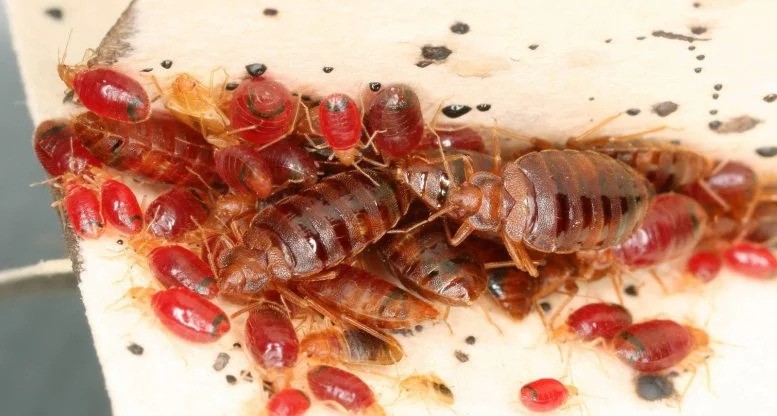 A Bedbug Infestation. (Photo Credit: Warren Booth)
A lot of people shiver or shudder at the mere
mention of the word “bedbugs.” I’m sure many Nigerian homes have had
their fair share of these tiny devils because, quite frankly, they seem to be
practically everywhere.
Most times, we focus on how much we hate them
and, of course, how to eliminate them. But I doubt that most people have
actually taken the time to learn about these tiny creatures.
As a member of the scientific community, it
is not unusual for us to read about different organisms. One day, my lecturer
came to class and told us to read about bedbugs for a class presentation.
I picked up my phone and started reading, and
I found some things that were so interesting that I thought, “Wait… people
need to know this.”
Let’s start with one of the biggest
misconceptions about bedbugs: they only live in dirty environments.
Not true.
You can have the cleanest space imaginable
and still have bedbugs. Cleanliness does not make a place immune to an
infestation. Bedbugs are primarily looking for a blood meal, and they use cues
such as carbon dioxide from our breath, body heat and other signals from
their hosts to locate us.
And then comes another shocking
fact: bedbugs can survive for several months without feeding under
suitable conditions.
Yes, months.
This is one reason why simply abandoning a
room for a short period does not necessarily eliminate an infestation. They can
remain hidden and wait for the host to return.
And for such tiny insects, they can cover a
surprising amount of ground. Bedbugs have been reported to travel more
than 100 feet in a single night, although they generally remain much closer to
where people sleep.
Then there is their body structure.
Bedbugs are incredibly flat. This allows them
to squeeze into tiny cracks and crevices that you might never imagine could
accommodate an insect. They can hide in mattresses, furniture, cracks in walls
and other small spaces, which is one of the reasons they can be so difficult to
eliminate completely.
Now, here’s another interesting part.
When a bedbug bites, you may not notice it
happening immediately. During feeding, the insect injects saliva containing
substances that help prevent blood from clotting and make feeding easier.
Some components of the saliva can also affect how our bodies respond to the
bite, which is why the itching and skin reaction may not always appear immediately.
But now, we get to what I consider the most
disturbing—and perhaps most fascinating—part.
Female bedbugs undergo something called
traumatic insemination during reproduction.
In simple terms, rather than mating through a
conventional reproductive opening, the male pierces the female’s abdomen with
his reproductive organ and deposits sperm into her body. The sperm eventually
makes its way to the reproductive system, where fertilisation can occur.
And yes, the name “traumatic
insemination” is exactly as intense as it sounds.
There is absolutely no romance involved. Just
pure biology doing what biology does.
And to make matters worse, female bedbugs can
produce hundreds of eggs over their lifetime, which is another reason an
infestation can become difficult to control.
So the next time you see a bedbug and
immediately reach for the insecticide, remember that you are looking at a
surprisingly complex little organism.
Tiny? Yes.
Annoying? Absolutely.
But biologically fascinating? Unfortunately, very much so.








Comments
Be the first to comment on this post
Leave a Reply