




What happens when an Idea makes People uncomfortable?
By ruth MALAGU
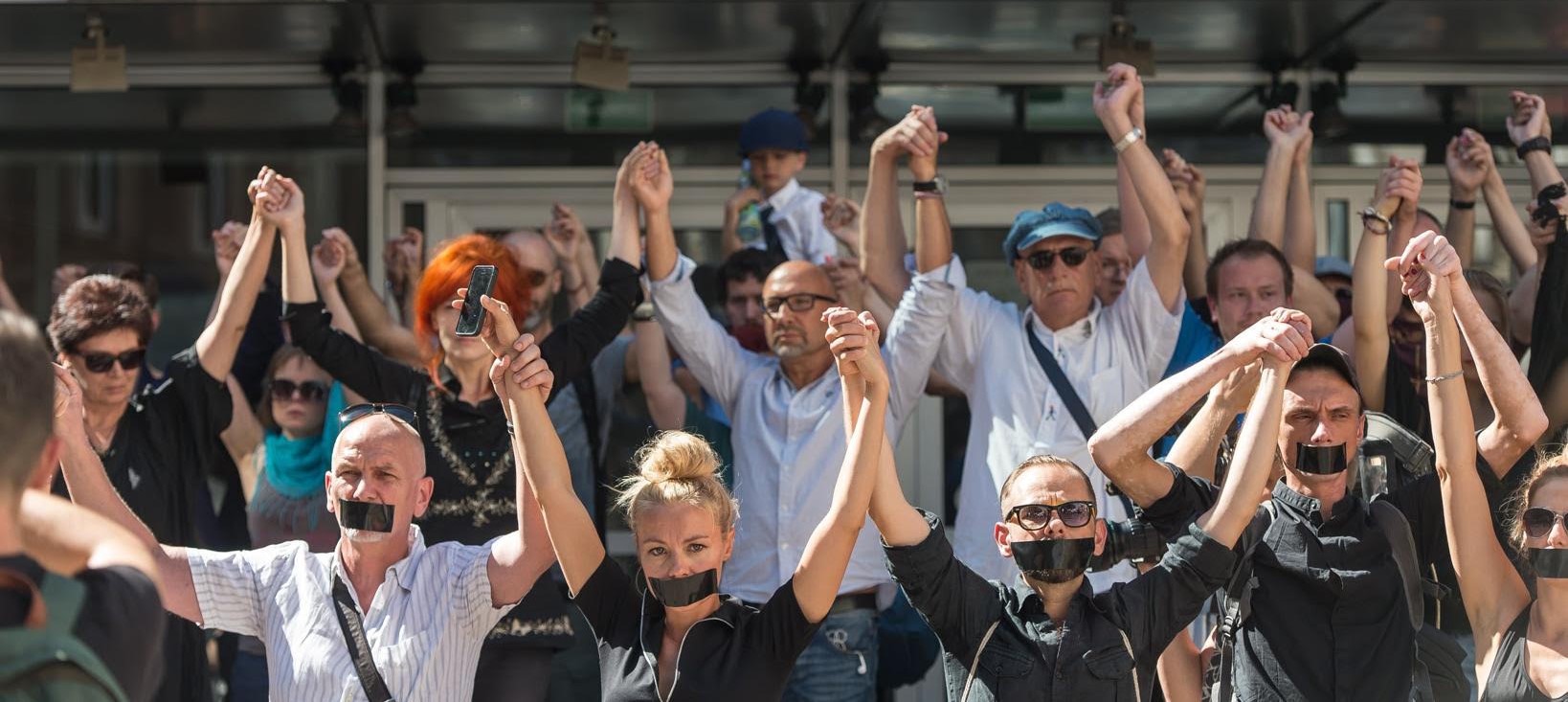 Photo Credit: Silent Protest of Artists of the Polish Theatre
On Artistic Freedom, Difficult Conversations and the Stories we are sometimes afraid to tell.
There is something interesting about the way people respond to stories they do not find comfortable. Sometimes they question them. Sometimes they criticise them. Sometimes they dismiss them entirely and sometimes they would rather the story had never been told in the first place but perhaps the more important question is this: What happens to an idea when the people who encounter it are not ready to hear it?
Every creative work begins somewhere. Sometimes it is a conversation overheard on a bus. Sometimes it is an experience that refuses to leave the mind. It could be a question about society, a disturbing observation about human behaviour or an issue people have spent years avoiding. An artist sees something, feels something or questions something, and an idea begins to take shape.
However, having an idea and bringing it to life are two very different things.
Not every idea becomes a story. Not every story becomes a script. Not every script makes it into production and not every production makes it to the stage. Between the conception of an idea and its presentation to an audience are several decisions, people, resources and sometimes uncomfortable conversations.
Consider an artist who wants to explore domestic violence, religious hypocrisy, political oppression, gender expectations, sexuality, corruption or the contradictions within a society. These are not necessarily unfamiliar subjects but the way an artist chooses to approach them can make all the difference.
The problem is not always the subject itself. Sometimes it is the perspective.
People may be comfortable watching a story about corruption until the character they admire is portrayed as corrupt. They may appreciate a play about injustice until it begins to question the institutions they trust. They may support artistic expression until the artist expresses something that challenges their own beliefs and suddenly, the conversation changes. Instead of asking what the work is trying to communicate, people begin asking why the artist would choose to communicate it at all.
This is where things become particularly interesting for theatre practitioners.
Theatre has always provided a space for human experiences to be examined. It allows us to observe ourselves through characters, conflicts and situations that may be fictional but often reflect realities we recognise. Sometimes, a performance makes us laugh. Sometimes, it moves us to tears and sometimes it leaves us sitting in silence, questioning things we would ordinarily rather not think about.
Not every production is meant to provide comfort. Some are meant to provoke thought. Others are meant to challenge familiar beliefs, expose uncomfortable realities or give a voice to experiences that have been ignored.
However, this does not mean that every controversial idea is automatically meaningful or that artists should be exempted from criticism. Artistic freedom does not mean freedom from responsibility. An artist must also consider the way a subject is represented, the people it affects and the message the work communicates.
There is a difference between challenging an audience and deliberately hurting one. There is also a difference between exploring a difficult subject and using controversy simply to attract attention.
The challenge is knowing where that line exists.
Unfortunately, the journey from an idea to a finished production can sometimes become a negotiation between artistic intention and public acceptance. A writer may be asked to change a scene. A director may be advised to approach a subject differently. A producer may hesitate because of the possible reactions from sponsors, institutions or audiences. A production may be considered too controversial, too sensitive or simply too uncomfortable to present and sometimes, the artist begins to question the work too.
Should that character really say those words? Should that scene remain? Is this subject worth the trouble it might cause? Will anyone be willing to produce it? Will the audience understand what I am trying to say?
These questions are not necessarily signs of weakness. They can be part of the creative process but when fear becomes the primary influence behind artistic decisions, something important may be lost.
We must also recognise that the audience is not a single individual with one opinion. What makes one person uncomfortable may give another person a sense of recognition. A story that one audience considers offensive may be the very story another has been waiting to see. This is why it becomes difficult to determine which stories deserve to be told based solely on how comfortable people feel about them.
Perhaps we have become so accustomed to asking whether a story will be accepted that we sometimes forget to ask whether it needs to be told.
Of course, not every story needs a stage, and not every idea needs an audience. Artists must make choices. Producers must consider resources and consequences. Institutions have their own responsibilities but disagreement alone should not automatically become a reason to silence a creative voice.
A society that only welcomes stories that affirm what it already believes may gradually lose the opportunity to examine itself and perhaps that is one of the most important things about storytelling: it does not always have to provide answers. Sometimes, its greatest contribution is asking the questions people have become too comfortable avoiding.
So, what happens when an idea makes people uncomfortable?
Does it get rewritten until everyone is satisfied? Does it remain in a writer's notebook? Does it become one of those scripts that people know exists but never get to see? Or does someone eventually find the courage, resources and opportunity to bring it to life?
Perhaps the responsibility of the artist is not to make everyone comfortable. Neither is it to provoke people simply for the sake of provoking them. It is to create with intention, to question with honesty and to understand that storytelling comes with both freedom and responsibility.
Because sometimes, the story that makes us uncomfortable is not necessarily the story that needs to disappear.
Sometimes, it is the story that deserves a conversation.








Comments
Be the first to comment on this post
Leave a Reply